


GRID™ Autosport
Feral Interactive
I went into GRID™ Autosport expecting a quick mobile racing game and came away with something much closer to a serious console-style driving experience. Developed by Feral Interactive, this paid racing game asks more from you than simply tapping a boost button and steering around forgiving corners. Its appeal is in the feeling of controlling a proper racing machine, learning each circuit, and gradually becoming more consistent rather than constantly chasing short-lived rewards.
That distinction matters. If you want a free game built around instant races, frequent gifts, and uncomplicated handling, this may feel demanding and expensive. If you would rather pay once for a substantial driving game and spend time improving your technique, it is one of the more convincing choices I have played on Android. The store presents it as console-quality racing, and while that description is broad, it matches the overall ambition I felt while playing.
What the first races ask from you
The early experience is not really about collecting a long list of upgrades as quickly as possible. It is about understanding how the car behaves. Braking too late, turning aggressively, or accelerating before the car is settled can cost far more time than I expected. That made my first sessions feel useful: every mistake gave me something concrete to correct on the next lap.
I especially liked that the game encourages a racing mindset instead of treating every event as a disposable sprint. I found myself watching corner entry points, choosing when to defend a position, and thinking about clean exits rather than only looking for the fastest possible line. Those goals are simple, but they create a stronger sense of purpose than a progression system based only on collecting currency.
The opening hours are also a good test of whether the game suits you. The driving model has enough weight that I could not rely on frantic swipes or careless steering. I had to become familiar with the controls, adjust the assistance options to my comfort level, and accept that a poor start could not always be rescued by dramatic last-second driving. That can be satisfying for patient players, but it is not the most welcoming approach for someone who wants immediate arcade-style success.
Related News

Threads in Real Life: Who Should Join, Lurk, or Leave

How SHEIN Turned Shopping Into an Endless Content Feed

How to Make Fortnite Feel Smarter on Mobile

Should You Switch to Microsoft Outlook on Mobile?

Why Gallery Keeps Pulling Users Back

X Review: Why Its Network Still Matters
One practical tip made a noticeable difference: I spent time tuning the control layout before judging the handling. On a small screen, a control position that feels fine in a short race can become awkward during a longer event. I also found it useful to begin with more assistance, then reduce it only after I could complete laps without fighting the interface. That turns the early learning period into a deliberate process instead of a series of unexplained losses.
Progress feels tied to driving quality
The strongest progress signal here is not a flashy reward screen. It is the moment when a circuit that previously felt impossible begins to make sense. I started recognizing where I was losing momentum and could tell whether a bad result came from braking, positioning, or overdriving the car. That kind of feedback is valuable because it gives improvement a clear cause.
There is also a satisfying rhythm to returning to an event after a few attempts. I might not win immediately, but a cleaner first sector or a better exit from a slow corner can show that I am moving in the right direction. In my experience, those small gains kept me engaged more effectively than a constant stream of unrelated unlocks would have done.
Gallery
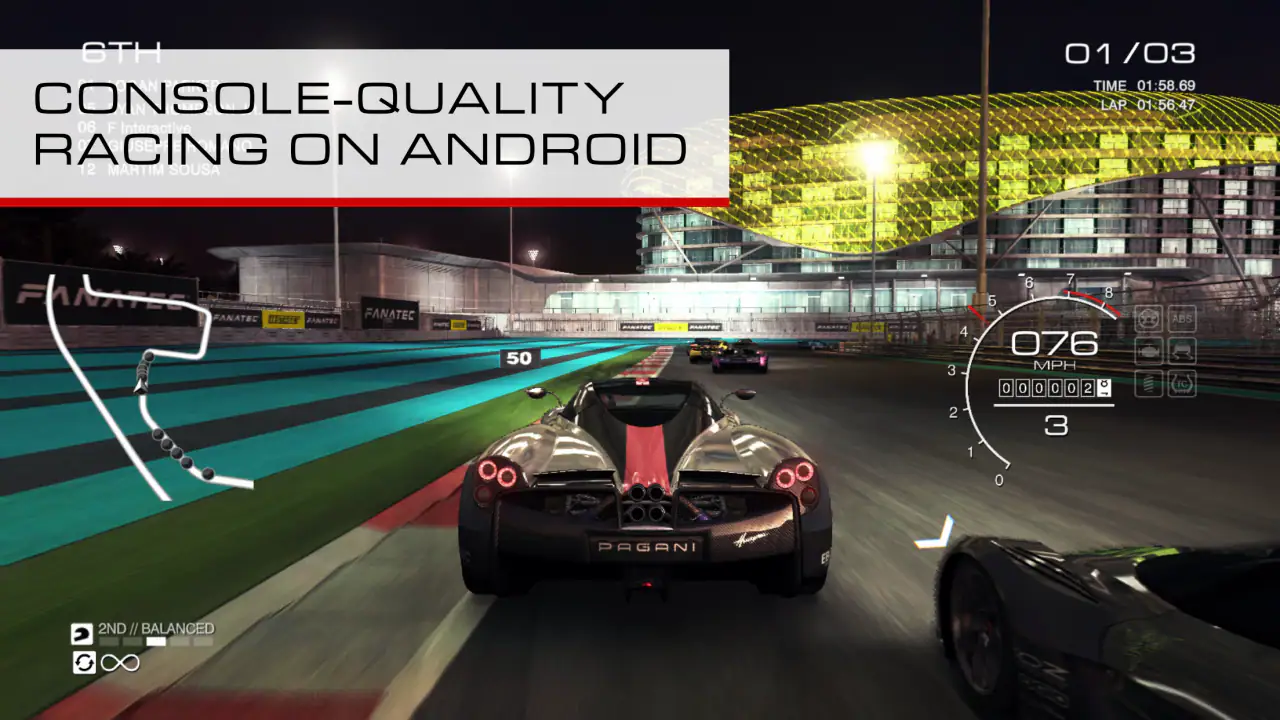
Still, players who need visible progression markers may find the structure less immediately rewarding than free-to-play rivals. Many mobile racers place a large emphasis on new cars, currencies, daily objectives, and frequent upgrade screens. GRID Autosport feels more focused on the race itself. That is a strength when I want depth, but a weakness when I am looking for a quick sense of accumulation after every session.
The game costs $9.99, so the progression question is important before buying. I see the price as a trade-off: you avoid the usual pressure to keep returning for timed rewards or to spend more for faster advancement, but you also do not receive the same stream of small incentives that free alternatives use to maintain attention. For me, paying upfront made it easier to play at my own pace. I did not feel pushed into treating every race as part of a retention schedule.
That does not mean the game lacks motivation. Its motivation is performance-based. I wanted to improve my lap, handle a difficult corner more cleanly, and prove that a previous result was not a fluke. This works best for players who enjoy mastery. It works less well for people who measure progress mainly through new visual items or a rapidly expanding garage.
How the difficulty curve changes the experience
The difficulty is not simply a matter of opponents becoming faster. The bigger challenge is learning how much speed a corner can actually carry and when aggression becomes a mistake. I often felt that the game was asking me to replace instinctive mobile-game habits with more disciplined racing decisions.
That curve can be fair, but it is not always gentle. A player who has little experience with simulation-leaning racing may interpret a poor result as a problem with the car when the real issue is braking too late. I had better results once I stopped trying to force every corner and began treating the opening laps as information-gathering. Learning the track is often more valuable than immediately chasing a perfect result.
Another useful approach is to separate practice from competition mentally. When I entered an event only thinking about winning, mistakes became frustrating and I tended to repeat them. When I used the race to identify one problem area, such as corner entry or throttle control, the same event became much more manageable. This is a small change in attitude, but it suits the way the game rewards careful repetition.
The assistance settings are important for accessibility and pacing. Newcomers should not feel obliged to disable everything at once. I found that gradual adjustment preserved the enjoyment while still leaving room to develop better control. Experienced racing players may prefer a more direct challenge, while casual players can keep support enabled until the circuits feel familiar.
There is a trade-off here that arcade racers usually avoid. More realistic behavior creates a stronger sense of achievement when I get a race right, but it also makes a short session less forgiving. If I only have a few minutes and want a guaranteed burst of excitement, a lighter arcade game is probably a better fit. GRID Autosport rewards attention, and attention is not always what I want from a phone.
Why the game can hold attention without constant pressure
The retention loop is built around improvement rather than obligation. I did not need a daily streak to justify opening the game. I could return after a break, remember a troublesome circuit, and continue working on the driving itself. That makes the experience feel more like a portable racing collection than a service designed to keep me checking in at fixed intervals.
This is particularly useful in an everyday situation. If I have a longer train journey or a quiet evening, I can settle into several races and focus on learning a track. If I only have a short break, I can still drive, but I am less likely to get the full benefit from a session when I am distracted or rushing. The game is portable, yet its best qualities appear when I give it enough concentration to notice what the car is doing.
The absence of constant pressure is also a limitation for some players. A free racing game may offer more immediate variety through rotating challenges, collectible targets, and regular rewards. Those systems can make a five-minute visit feel productive. GRID Autosport instead asks me to create my own reason for returning. I return because I want a cleaner result, not because a timer is demanding attention.
I would also avoid buying it solely because it is popular. The game has a 4.6 average from around 45 thousand ratings, and it has passed 500 thousand installs, but those figures do not change the central question: do you enjoy demanding driving? The audience response suggests strong interest, yet a highly rated racing game can still be the wrong purchase for someone who prefers simple controls and instant victories.
The age rating is Everyone, which makes the game broadly approachable in terms of content. That should not be confused with a beginner-friendly difficulty level. The presentation is suitable for a wide audience, but the driving may still ask younger or inexperienced players for patience. I would introduce it as a racing game that can be accessible with the right settings, not as a game that removes every technical challenge.
Where it stands beside ordinary mobile racers
Compared with the usual free-to-play racing alternatives, the biggest difference is the relationship between the player and the purchase. In many competing games, the first question is how quickly a car can be improved or how often the game can offer another reward. Here, I spent more time thinking about the track, the car, and my own decisions.
That makes GRID Autosport a better choice for someone who dislikes energy limits, aggressive monetization, or progression that feels slowed down unless money is spent. The upfront price is easier to understand than a long chain of optional purchases. At the same time, it means there is less of the constant novelty that makes free racers attractive. You are paying for the driving experience, not for an endless sequence of surprise incentives.
Compared with a dedicated console or computer racing setup, the phone version is more convenient but naturally more dependent on the device and control method. Touch controls can work well after adjustment, yet a physical controller may feel more precise for players who are used to one. I would not choose this as a replacement for a full racing wheel or a large-screen setup, but I do think it succeeds as a serious portable option.
The Android requirements also deserve attention. The game requires Android 9 or later, and the current version is 1.10.6RC3. Before purchasing, I would check that the phone is compatible and that its screen and controls are comfortable for longer races. A powerful-looking game can still be a poor fit if the device makes steering cramped or the display difficult to read.
One of my more useful habits was to treat the phone as a racing device during play rather than as a notification machine. Turning off distractions, using a stable grip, and choosing a comfortable brightness level made the handling feel more consistent. This is not a hidden feature, but it changes the practical experience considerably because concentration affects how well I read corners and react to mistakes.
The progression verdict for different kinds of players
After spending time with it, I think the progression succeeds because it gives improvement room to breathe. The game does not need to flood me with rewards when the driving itself provides a clear target. Learning a circuit, becoming smoother with inputs, and turning a frustrating event into a controlled result are meaningful milestones.
Its pacing is strongest for players who enjoy gradual mastery. I can imagine recommending it to a friend who talks about racing lines, braking points, and the difference between a fast lap and a messy one. I would also recommend it to someone who wants a substantial paid game rather than a free download built around repeated prompts to return or spend.
I would be more cautious with a player who wants a relaxed arcade racer for occasional one-handed play. The price may feel hard to justify if they only want short bursts of uncomplicated action. Likewise, someone who expects a visible reward after every race may find the progression restrained. In those cases, a simpler arcade alternative could offer more immediate satisfaction.
For my own use, the best part is that the game respects the idea of practice. It lets a bad result remain a bad result instead of disguising it with automatic assistance or excessive reward. That can be uncomfortable, but it also makes a good result feel earned. The main friction is that the same seriousness can make the experience less flexible when I am tired, distracted, or playing on a cramped screen.
My recommendation is straightforward: choose GRID™ Autosport if you want the racing itself to be the progression system. The paid model, technical handling, and measured pacing make it a poor match for players seeking casual novelty, but a strong match for anyone prepared to learn. Feral Interactive has created a mobile racer that I would rather revisit for one genuinely better lap than for a pile of artificial rewards, and that is exactly why it has stayed interesting to me.
FAQs for GRID™ Autosport
What is GRID™ Autosport, and what kind of racing experience does it offer?
GRID™ Autosport is a premium racing game focused on realistic driving, competitive events, and a wide selection of motorsport disciplines. Instead of offering only short arcade races, it combines touring cars, open-wheel vehicles, endurance events, street races, and more. The game is designed for players who enjoy responsive controls, detailed tracks, and a more serious racing experience on mobile.
Is GRID™ Autosport free to download and play?
GRID™ Autosport is generally a paid premium game, so you normally need to purchase it before downloading or playing the full experience. This approach means it does not rely heavily on energy systems, intrusive advertising, or constant microtransactions. However, pricing and availability can vary between the Google Play Store and Apple App Store, so check the current store listing before purchasing.
Does GRID™ Autosport work on all Android and iOS devices?
No, GRID™ Autosport requires relatively powerful hardware because of its advanced graphics, detailed vehicles, and demanding physics simulation. Older or entry-level phones and tablets may not be supported, or they may provide an inferior experience with reduced performance. Before downloading, review the official store requirements and make sure your device has enough free storage, memory, and a compatible operating system.
Can GRID™ Autosport be played offline?
GRID™ Autosport is well suited to offline play, which is one of its most attractive features for mobile users. Many of its racing modes and career content can be enjoyed without a continuous internet connection after installation. An internet connection may still be required for downloading the game, receiving updates, checking purchases, or accessing any platform-related services available in your version.
Does GRID™ Autosport support controllers and customizable controls?
The game offers several control options so players can choose the setup that feels most comfortable. Depending on the device and operating system, you can typically use touch controls, tilt steering, or a compatible external controller. Controller support can vary by model and platform, so confirm compatibility if you plan to play with a Bluetooth gamepad. Adjusting sensitivity and assistance settings can also make the driving experience more manageable.
Pros
- Console-quality graphics and detailed car models
- Excellent handling options for both casual and skilled racers
- Large selection of cars
- tracks
- and racing disciplines
- Supports offline play without requiring a constant internet connection
- Precise controller support improves the racing experience
Cons
- Requires substantial storage space for the full game and extra content
- High visual quality can drain battery quickly on mobile devices
- Performance varies noticeably across older or budget phones
- Touch controls may feel difficult during fast
- technical races
- Premium price may deter players expecting a free-to-play experience


